St. Gregory the Great
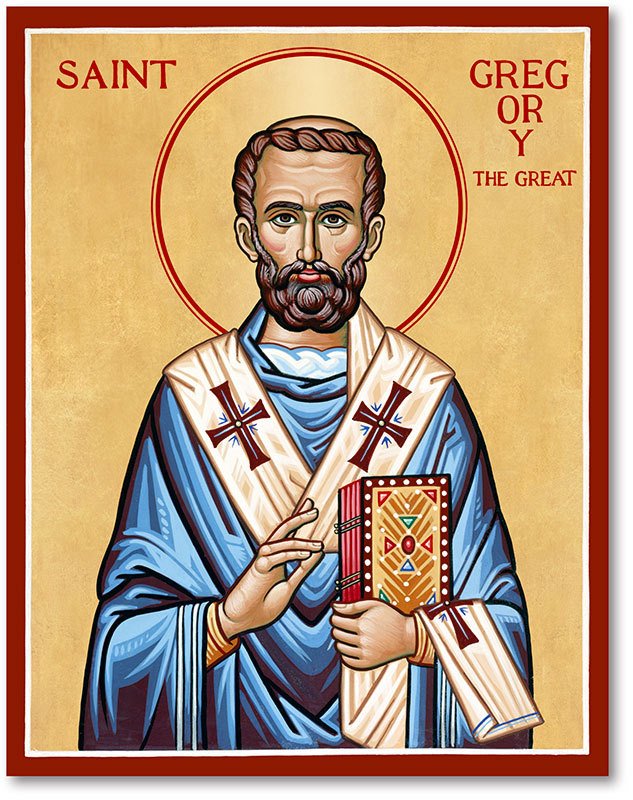
| Feast Day | September 3 |
|---|---|
| Patronage |
|
| Place of Birth | Rome, Italy |
| Place of Death | Rome, Italy |
| Canonization Date | N/A |
Biography
Saint Gregory I, known as Gregory the Great, was a pope, theologian, and Church reformer who played a key role in shaping medieval Christianity. Born into a wealthy Roman family, he initially pursued a political career, becoming Prefect of Rome around 573 AD. However, he soon abandoned public life to become a Benedictine monk, dedicating himself to a life of prayer and service.
In 590 AD, Gregory was elected Pope during a time of political instability, plague, and famine. His leadership transformed the Church, and he is credited with:
- Strengthening papal authority and establishing the Papal States.
- Promoting missionary work, notably sending Saint Augustine of Canterbury to evangelize England.
- Reforming the liturgy and developing Gregorian Chant, a style of sacred music.
- Writing pastoral and theological works, including Pastoral Rule, a guide for bishops.
Despite facing wars, plagues, and invasions, Gregory’s humility, wisdom, and charitable works earned him the title “Servant of the Servants of God”, a phrase still used by popes today.
Miracles & Important Events
- Miraculous relief of the plague: During a plague in Rome, Gregory led a public prayer procession, after which the plague subsided.
- Saint Michael’s apparition: He saw the Archangel Michael sheathing his sword over Rome, signaling the plague’s end.
- Conversion of England: His mission to the Anglo-Saxons laid the foundation for Christianity in England.
- Writings that shaped Church doctrine, including extensive commentary on scripture, morality, and pastoral care.
Associated Symbols
- Papal tiara and crozier (symbolizing his papal authority)
- Dove on his shoulder (representing divine inspiration)
- Book and quill (his theological writings)
- Gregorian Chant notation (for his contribution to Church music)
Quotes & Writings
- “I have carefully avoided elevating myself above others, and I have labored with all my strength to avoid vainglory.”
- “The proof of love is in the works. Where love exists, it works great things.”
- “Non Angli, sed angeli.” (Not Angles, but angels.) – Upon seeing Anglo-Saxon slaves in Rome, inspiring him to send missionaries to England.