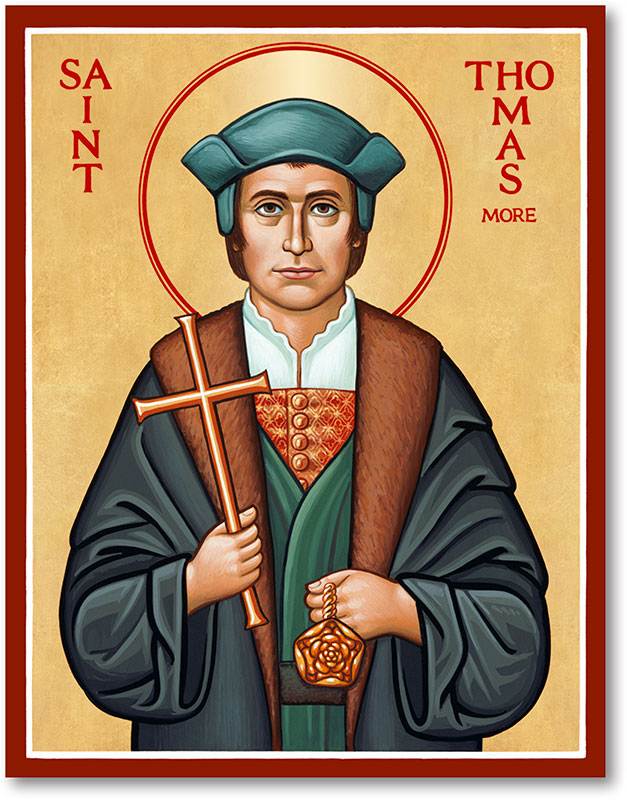
St. Thomas More
| Feast Day | June 22 |
|---|---|
| Patronage |
|
| Place of Birth | London, England |
| Place of Death | Tower Hill, London, England |
| Canonization Date | May 19, 1935 |
Biography
St. Thomas More was a renowned English lawyer, scholar, and statesman. He was born to a wealthy family in London and became a prominent figure in the court of King Henry VIII. More was a devout Catholic and famously opposed King Henry’s decision to break from the Roman Catholic Church and establish the Church of England. This opposition was primarily based on his refusal to accept the King’s authority as the Supreme Head of the Church in England, especially regarding the King’s marriage to Anne Boleyn.
In 1535, More was imprisoned in the Tower of London and subsequently executed for refusing to take the Oath of Supremacy, which recognized the king’s authority over the Church in England. He is revered as a martyr for his defense of the Catholic faith, his unwavering commitment to truth, and his moral integrity.
Miracles & Important Events
While there are no specific miracles attributed to St. Thomas More, his life and martyrdom itself are considered a profound testimony to the power of conviction and faith. His refusal to compromise on religious truth, even in the face of death, has inspired many.
Associated Symbols
- The Axe: Symbolizing his execution.
- Books or Scrolls: Representing his scholarly life and intellectual contributions.
- Sword: Symbolizing his role as a lawyer and public servant.
Quotes & Writings
- “I die the King’s faithful servant, but God’s first.” — This is one of his most famous statements, made before his execution.
- “Give me the grace, good Lord, to set the world at naught, to set my mind firmly on Thee, and not to hang on the wretched world.”
- “The King’s good servant, but God’s first.” — An expression of his loyalty to both his country and his faith, though his ultimate loyalty was to God.
He is also the author of several important works:
- Utopia (1516): His most famous work, which outlines an ideal society based on reason, justice, and equality, often critiquing the social and political conditions of his time.
- Dialogue of Comfort Against Tribulation: A work that provides a spiritual response to suffering, focusing on how to cope with adversity from a Christian perspective.
- The Apology: A defense of his conduct and conscience in the face of charges brought against him during his trial.