St. Luke
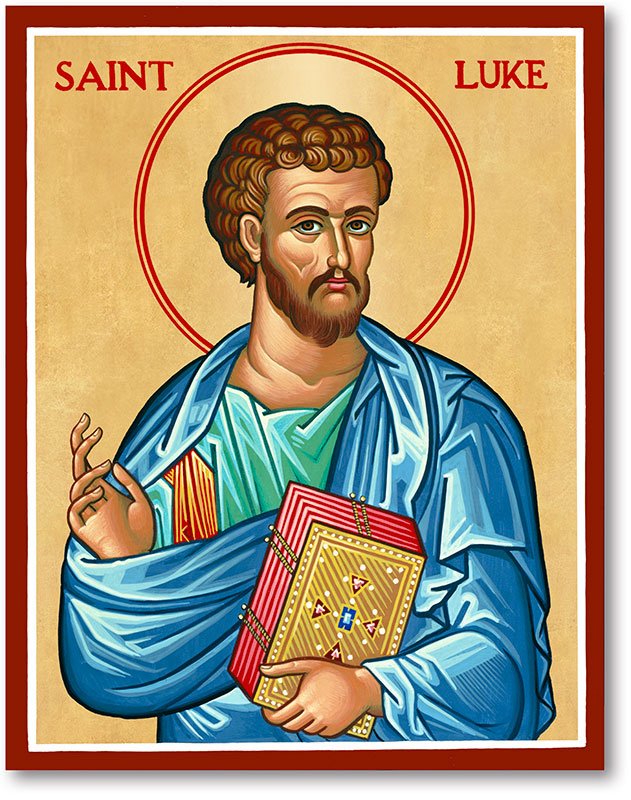
| Feast Day | October 18 |
|---|---|
| Patronage |
|
| Place of Birth | Antioch, Syria (now Antakya, Turkey) |
| Place of Death | Boeotia, Greece (possibly Thebes) |
| Canonization Date | N/A |
Biography
St. Luke the Evangelist is best known as the author of the Gospel of Luke and the Acts of the Apostles, two foundational texts of the New Testament. Likely a Gentile convert to Christianity, he was a well-educated man, traditionally identified as a physician (based on Colossians 4:14, where Paul calls him “the beloved physician”). Born in Antioch, a major center of early Christianity, Luke is thought to have been of Greek descent, fluent in Greek, which he used to write his eloquent and detailed works.
Luke joined St. Paul on his missionary journeys, possibly meeting him in Troas around 51 AD (Acts 16:10 shifts to “we,” suggesting Luke’s presence). He accompanied Paul through Macedonia, Greece, and eventually to Rome, remaining loyal during Paul’s imprisonments (2 Timothy 4:11). His Gospel, written between 70-85 AD, emphasizes Jesus’ compassion, outreach to the marginalized (women, the poor, Gentiles), and the role of the Holy Spirit. Acts continues this narrative, chronicling the early Church’s growth. Unlike the other Gospel writers, Luke did not know Jesus personally but relied on eyewitness accounts and prior sources (Luke 1:1-4).
Tradition holds that Luke was unmarried, lived a life of celibacy, and died peacefully in Greece, possibly as a martyr (though evidence for martyrdom is weak). After his death, his relics were venerated, eventually transferred to Constantinople in the 4th century and later to Padua, Italy, where they remain today. Luke’s legacy as a historian, evangelist, and companion of Paul endures through his writings and artistic tradition.
Miracles & Important Events
- Authorship of Gospel and Acts: His writings, inspired by the Holy Spirit, are considered miraculous for their preservation and influence on Christianity.
- Healing Presence: As a physician, he likely aided Paul and others physically and spiritually, though specific miracles are not detailed in Scripture.
- Relics’ Healing Power: Posthumously, his relics in Padua and elsewhere are credited with miracles, such as healings reported by pilgrims.
- Conversion of Gentiles: His work with Paul helped spread Christianity beyond Jewish communities, a pivotal event in Church history.
- Survival of Paul’s Trials: Luke’s presence during Paul’s shipwrecks and imprisonments (Acts 27-28) underscores his steadfastness, seen as providential.
Associated Symbols
- Winged Ox: One of the four evangelist symbols (from Ezekiel 1 and Revelation 4), representing sacrifice and service, tied to Luke’s focus on Jesus’ sacrificial love.
- Book or Scroll: Symbolizing his authorship of the Gospel and Acts.
- Physician’s Tools: Such as a medical bag or instruments, reflecting his profession.
- Paintbrush and Palette: From the tradition of painting Mary’s portrait.
- Haloed Virgin and Child: Often depicted with Luke in art, based on the legend of his painting.
Quotes & Writings
Quotes (from his works, as no personal sayings outside Scripture are preserved):
- “The Son of Man came to seek and to save the lost.” (Luke 19:10)
- “To whom much is given, much will be required.” (Luke 12:48)
- “He has brought down the mighty from their thrones and exalted those of humble estate.” (Luke 1:52, from the Magnificat)
- “And they were all filled with the Holy Spirit and spoke the word of God boldly.” (Acts 4:31)
Writings:
- Gospel of Luke: Third Gospel, emphasizing Jesus’ mercy, parables (e.g., Good Samaritan, Prodigal Son), and the role of women.
- Acts of the Apostles: A historical account of the early Church, from Pentecost to Paul’s imprisonment in Rome.