St. Anthony the Great
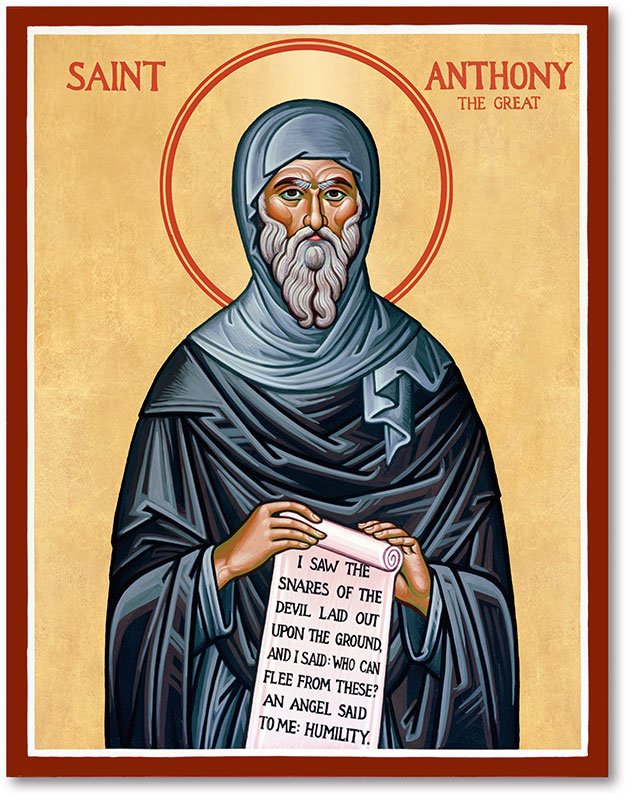
| Feast Day | January 17 |
|---|---|
| Patronage |
|
| Place of Birth | Coma (near Heracleopolis, Egypt) |
| Place of Death | Mount Kolzim (Egypt) |
| Canonization Date | N/A |
Biography
St. Anthony the Great (c. 251 – January 17, 356 AD), also known as St. Antony of Egypt, is widely considered the founder of Christian monasticism. Born into a wealthy Christian family, Anthony was inspired by the words of Jesus in Matthew 19:21, “If you would be perfect, go, sell what you possess and give to the poor,” and decided to sell his inheritance and live a life of asceticism.
He retreated into the desert, where he lived a life of extreme isolation, prayer, and penance. Over time, his reputation for holiness and wisdom spread, and many followers came to seek his guidance. Anthony is often credited with organizing the first Christian monastic communities, emphasizing solitary asceticism but also fostering communal living among those who sought to live according to the monastic rule.
He fought many spiritual battles, including temptations and visions of demons, but his commitment to God remained unshaken. Anthony’s life and spiritual struggles were chronicled by St. Athanasius, who wrote “The Life of Anthony,” which became an influential work in spreading the monastic movement.
Anthony died at the age of 105 after spending nearly 80 years in the desert. He is venerated as the patron saint of monks, and his legacy of asceticism, spiritual warfare, and dedication to God has influenced countless generations of Christians.
Miracles & Important Events
- Miracles of Healing: St. Anthony was known for performing many miracles, especially healing the sick and casting out demons. His influence in the Egyptian desert and in nearby communities led many to seek his intercession for physical and spiritual ailments.
- Victory Over Demons: The “Life of Anthony” describes various temptations and visions he experienced, including demonic attacks. Despite these trials, Anthony stood firm in his faith, and his victory over evil became a symbol of the power of Christian asceticism and devotion to God.
- Founding of Christian Monasticism: While Anthony did not formally create a monastic order, his example and influence were pivotal in the development of Christian monasticism. He is often referred to as the “Father of Monasticism” for his role in shaping the ascetic life that became the foundation of many monastic orders.
- The Life of Anthony by Athanasius: The biographical account written by St. Athanasius is one of the most important sources of information about St. Anthony’s life and his struggles. It also became a powerful text that helped spread the monastic movement in the Christian world.
Associated Symbols
- A pig (symbolizing the temptations and struggles he faced and also associated with his name, as the “Holy Fire” was said to affect pigs)
- A staff (as a symbol of his monastic leadership)
- A book (representing his spiritual wisdom and writings)
- A circle or the “Antony Cross” (a symbol of St. Anthony, derived from his name, which is shaped like a combination of the letter “T” and “A”)
Quotes & Writings
- “The one who has seen God is no longer afraid of the world.” — This quote reflects St. Anthony’s deep spiritual commitment and his view that, through monastic discipline and faith, one could experience divine presence and be free from fear.
- “The devil tempts us in three ways: by our own desires, by the world, and by the flesh.” — St. Anthony is often depicted as having battled intense temptations in the desert, and this quote highlights the Christian teaching on the nature of temptation and spiritual warfare.
- “Whoever wishes to be a true servant of God must first of all take the cross upon himself.” — This quote reflects St. Anthony’s commitment to asceticism and the idea that true Christian life involves a willingness to suffer and make sacrifices for the sake of following Christ.
- “The greatest work of a Christian is to pray, and the most necessary thing for a monk is to be alone with God.” — This speaks to St. Anthony’s belief that solitude and prayer were vital for deepening one’s relationship with God and achieving spiritual purity.