St. Catherine of Siena
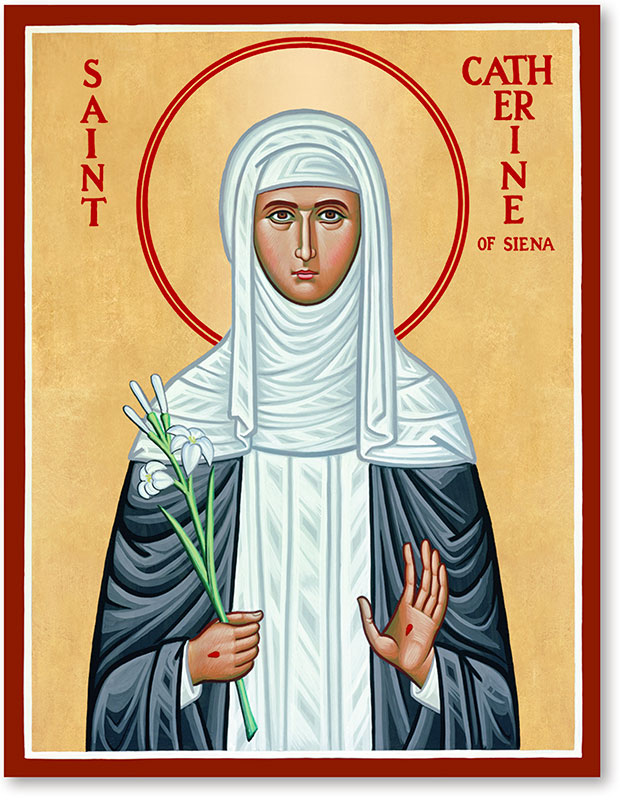
| Feast Day | April 29 |
|---|---|
| Patronage |
|
| Place of Birth | Siena, Italy |
| Place of Death | Rome, Italy |
| Canonization Date | June 22, 1461 |
Biography
St. Catherine of Siena was one of the most influential and beloved saints of the Catholic Church, known for her deep spirituality, mysticism, and powerful role in both the religious and political life of her time. Born in Siena, Italy, she was the 25th of 25 children in her family, and from a young age, she exhibited a strong desire to serve God.
Catherine joined the Third Order of St. Dominic at the age of 16, though she did not take formal vows. She devoted her life to prayer, penance, and acts of charity. Her mysticism included visions, locutions, and a profound experience of union with God. Catherine became a counselor to popes, political leaders, and ordinary people, advocating for reform in the Church and in society.
She is credited with playing a pivotal role in persuading Pope Gregory XI to return the papacy to Rome from Avignon, thus ending the period of the Avignon Papacy. She was also instrumental in attempting to bring about peace in Italy and restore unity within the Church, which was experiencing internal divisions.
She died at the young age of 33, and her legacy has had a lasting impact on the Church. St. Catherine was declared a Doctor of the Church by Pope Paul VI in 1970, one of the few women to receive this honor.
St. Catherine of Siena’s legacy continues to inspire Christians worldwide. As one of the most influential women in Catholic history, she exemplified the role of women in both spiritual and social life. Her mystical experiences, deep faith, and tireless work for the Church make her a patron and model for those seeking to live out their faith in the world.
Her writings remain an essential part of Christian spiritual literature, and her status as a Doctor of the Church highlights the profound impact she had on theology and spirituality. St. Catherine’s commitment to holiness and her courage in the face of adversity continue to be celebrated in the Church today.
Miracles & Important Events
- Mystical Experiences: Catherine’s life was marked by extraordinary mystical experiences. She reported receiving visions of Christ, the Virgin Mary, and various saints, as well as being spiritually married to Christ.
- Stigmata: It is believed that Catherine received the invisible stigmata, the wounds of Christ, which were a sign of her union with Christ’s suffering. Although the wounds were not externally visible, she carried these wounds spiritually.
- Advocacy for the Papacy: St. Catherine was instrumental in persuading Pope Gregory XI to return the papacy to Rome from Avignon in 1377. Her influence was pivotal in ending the so-called Babylonian Captivity of the Papacy, a period when the papacy had been located in Avignon, France, instead of Rome.
- Letters and Treatises: She is known for her letters (more than 380 surviving letters), many of which were sent to religious and political figures. Her “Dialogue of Divine Providence” is a profound spiritual treatise that became one of her most influential writings.
Associated Symbols
- Lily: Symbolizing her purity and holiness, lilies are often depicted with St. Catherine in art.
- Crown of Thorns: Represents her intense suffering and mystical union with Christ, especially her experience of spiritual marriage to Christ.
- Heart: Often shown with a heart or hearts, representing her love for God and her deep spirituality.
- Book or Quill: Refers to her extensive writings, including letters and spiritual treatises, which are central to her legacy.
- The Stigmata: While she did not bear visible stigmata, St. Catherine experienced mystical wounds of Christ, particularly a wound on her heart.
Quotes & Writings
St. Catherine of Siena’s writings and sayings are filled with deep spiritual insight and eloquence. Some of her famous quotes include:
- “Be who God meant you to be and you will set the world on fire.”
- “If you are what you should be, you will set the whole world on fire.”
- “Nothing great is ever achieved without much enduring.”
- “All the way to heaven is heaven, because He said, ‘I am the Way.’”
- “In the night of life, don’t fear the darkness, for it is in the darkness that you will find the light.”
Her “Dialogue of Divine Providence” and letters to various popes, politicians, and religious figures are also highly revered texts in the Church. These writings deal with themes such as divine love, the nature of God’s providence, and the importance of personal holiness.