St. Joan of Arc
| Feast Day | May 30 |
|---|---|
| Patronage |
|
| Place of Birth | Domrémy, France |
| Place of Death | Rouen, France |
| Canonization Date | May 16, 1920 |
Biography
St. Joan of Arc, often referred to as the Maid of Orléans, was a young French peasant girl who, inspired by religious visions and voices, became a military leader during the Hundred Years’ War. At the age of 17, Joan convinced Charles VII, the Dauphin of France, to allow her to lead an army to lift the siege of Orléans, a pivotal moment in the war. Her leadership and courage in battle helped secure several victories for the French army and ultimately led to Charles VII’s coronation as King of France.
Joan’s success in battle, combined with her strong faith and belief that she was chosen by God, made her a symbol of hope for the French people. However, she was captured by the English in 1430 and was tried for heresy, witchcraft, and cross-dressing (she wore male military attire). Joan was convicted and burned at the stake in Rouen in 1431, at the age of 19.
Her trial and execution were politically motivated, and after her death, her case was reopened, and she was exonerated in 1456 by a posthumous retrial. In 1920, she was canonized as a saint by the Catholic Church.
Miracles & Important Events
- Visions and Voices: Joan claimed to have received visions and messages from saints and angels, including St. Michael, St. Catherine of Alexandria, and St. Margaret of Antioch, who instructed her to support Charles VII and help him reclaim his kingdom from the English.
- Victory at Orléans: Joan played a pivotal role in lifting the siege of Orléans in 1429, which marked a turning point in the Hundred Years’ War. Her leadership and faith inspired the French army and restored hope to the French people.
- Coronation of Charles VII: Joan’s efforts led to the successful coronation of Charles VII as King of France in Reims, a significant achievement that solidified French resistance to English occupation.
Associated Symbols
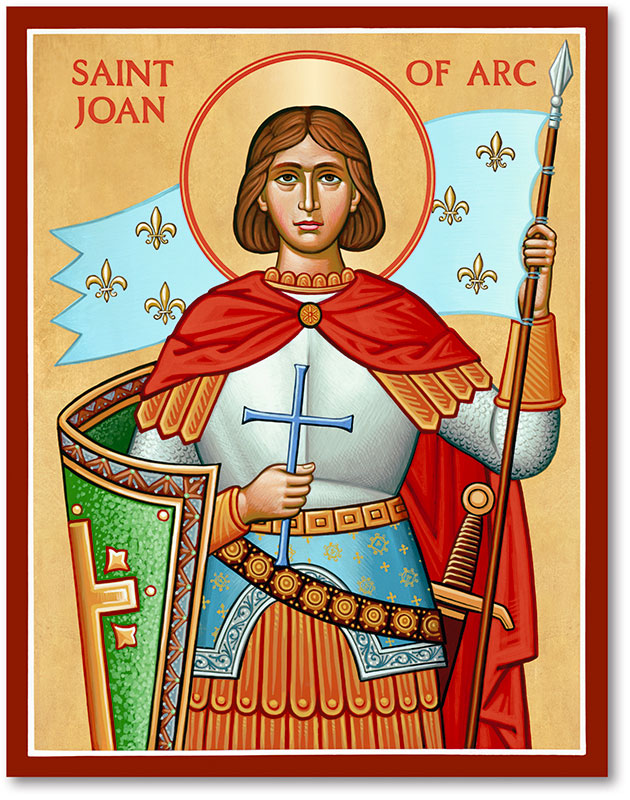
- Sword: Symbolizes her military leadership and role in battle.
- Armor: Reflects her role as a military leader during the Hundred Years’ War.
- Flag: She was known for carrying a banner into battle, often bearing images of Christ and the saints.
- Crown: Represents her role in securing the coronation of King Charles VII.
- Sheep or Lamb: As a symbol of her innocence and purity, common in religious art depicting her.
Quotes & Writings
- “I am not afraid… I was born to do this.”
- “If I am not in the grace of God, may He put me there; and if I am, may He so keep me.”
- “God has given me the mission to go and save France.”
- “I am the Maid of Orléans, sent by God.”