St. David of Wales
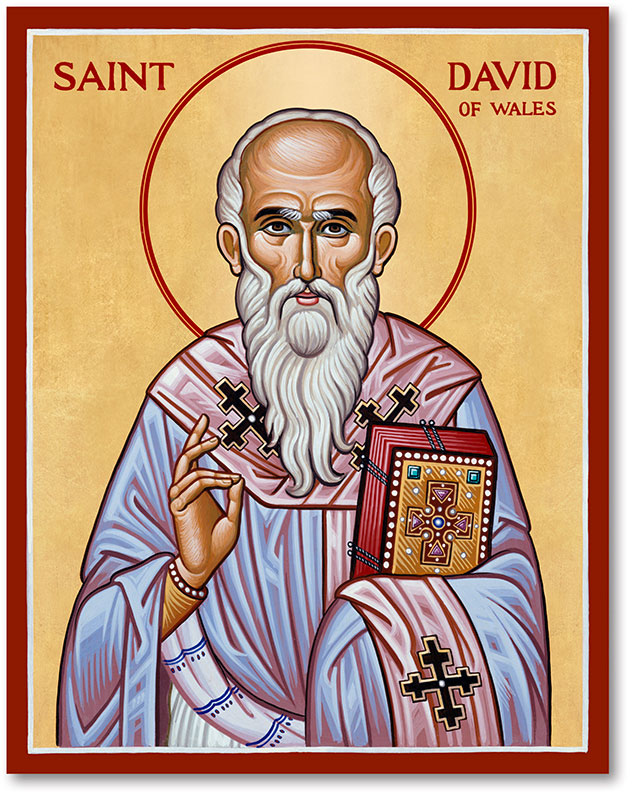
| Feast Day | March 1 |
|---|---|
| Patronage |
|
| Place of Birth | Henfynyw, Ceredigion, Wales |
| Place of Death | St. Davids, Pembrokeshire, Wales |
| Canonization Date | N/A |
Biography
Saint David (Dewi Sant in Welsh) is the patron saint of Wales and one of the most important figures in Welsh Christian history. He was born in the 6th century to Saint Non, a noblewoman, and was said to be a relative of King Arthur. Raised in a monastic environment, David became a renowned preacher, teacher, and missionary, spreading Christianity throughout Wales and the surrounding regions.
David founded many monasteries, the most famous being Glyn Rhosyn (now St Davids Cathedral in Pembrokeshire). His monasteries followed a strict, ascetic rule, where monks engaged in manual labor, prayer, and study, eating only bread, vegetables, and drinking only water—earning him the nickname “the Waterman.”
He was known for his miraculous works and deep spirituality. According to legend, during a sermon at the Synod of Llanddewi Brefi, the ground beneath him rose into a hill, allowing everyone to hear his words. A white dove, symbolizing the Holy Spirit, was said to have landed on his shoulder, further marking him as a holy man.
David died around 589 AD and was buried at his monastery. His shrine in St Davids Cathedral became a major pilgrimage site, visited by many, including medieval kings.
Miracles & Important Events
- The Hill Miracle: While preaching at the Synod of Llanddewi Brefi, the ground rose beneath his feet, ensuring that all could hear him.
- Healing Miracles: He was credited with healing the blind and the sick.
- Founding of Monasteries: His monastic rule emphasized poverty, humility, and a vegetarian diet, influencing many future religious communities.
- Pilgrimage Site: His tomb became a significant medieval pilgrimage destination; visiting St Davids twice was said to be equal to a pilgrimage to Rome.
Associated Symbols
- Dove (symbolizing the Holy Spirit’s presence during his sermon)
- Leek (a symbol of Wales; legend says he advised Welsh soldiers to wear leeks in battle)
- Monastic staff or crozier
- Hill or rising ground (recalling the miracle at Llanddewi Brefi)
Quotes & Writings
- “Do the little things in life.” (His most famous saying, still a popular Welsh phrase today)
- “Be joyful, keep your faith, and do the little things that you have heard and seen me do.”