St. Florian
| Feast Day | May 4 |
|---|---|
| Patronage |
|
| Place of Birth | Roman province of Noricum (modern-day Austria) |
| Place of Death | Lorch, Roman Empire (modern-day Austria) |
| Canonization Date | N/A |
Biography
Saint Florian was a Roman officer and Christian martyr who lived in the 3rd century. He served as a high-ranking military officer in the Roman army, responsible for overseeing firefighting brigades in the province of Noricum (present-day Austria). During Emperor Diocletian’s persecution of Christians, Florian refused to renounce his faith and was arrested. He openly declared his Christianity and defended persecuted Christian soldiers under his command.
When he refused to make a sacrifice to the Roman gods, he was tortured and sentenced to death. According to tradition, Florian told his captors that if they planned to kill him by fire, they should light the flames quickly, as he was unafraid of dying. Instead of burning him alive, they tied a millstone around his neck and threw him into the Enns River near Lorch on May 4, 304 AD.
Miracles & Important Events
- Miraculous Discovery: After his death, his body was reportedly discovered by an eagle, which guarded it until Christians retrieved and properly buried it.
- Protection Against Fire: Over the centuries, people invoked Saint Florian’s intercession for protection from fires and disasters. Many firefighters and towns dedicated to fire prevention honor him as their patron.
- Relics in Kraków: His relics were transferred to Kraków, Poland, in 1184, further solidifying his role as a patron saint of Poland.
Associated Symbols
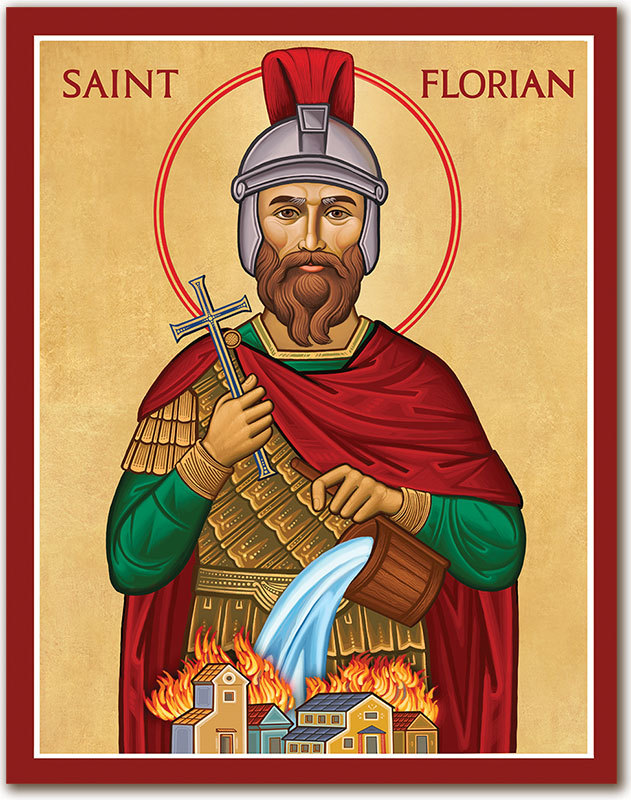
- Roman soldier’s armor
- A bucket of water or a burning building (symbolizing firefighting)
- Millstone (representing his martyrdom)
- Enns River (where he was drowned)
Quotes & Writings
- “If you wish to burn me, light the fire; I fear no flames.”