St. Hildegard of Bingen
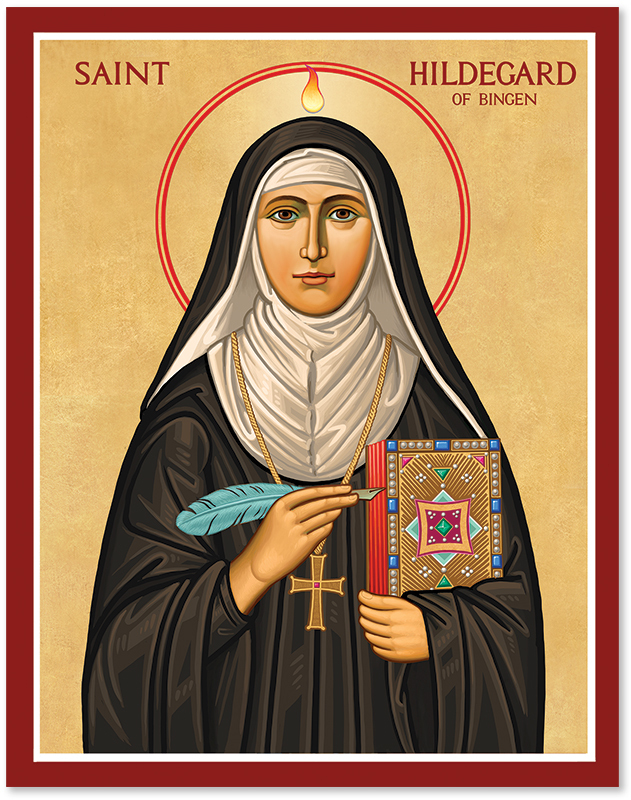
| Feast Day | September 17 |
|---|---|
| Patronage |
|
| Place of Birth | Germany |
| Place of Death | Germany |
| Canonization Date | May 10, 2012 |
Biography
St. Hildegard of Bingen was a visionary, mystic, abbess, composer, and theologian, known for her intellectual, spiritual, and artistic contributions to the Church and society. Born into a noble family, Hildegard was given to the Church at a young age and entered the Benedictine monastery at Disibodenberg when she was around 8 years old. Throughout her life, she experienced profound visions that she believed were divine revelations.
Hildegard’s visions, which began when she was a child, continued throughout her life, and she wrote about them in a series of theological works, such as Scivias (Know the Ways). These writings were highly regarded in her time and have remained influential in Christian thought. She was also known for her music, composing a vast amount of sacred music, including hymns and chants.
In addition to her spiritual writings and music, Hildegard was a skilled herbalist and physician. She wrote works on natural history, including Physica and Causae et Curae, which remain some of the earliest texts on herbal medicine. As abbess of Rupertsberg, she oversaw a thriving community, establishing one of the most renowned monastic centers of her time. She was known for her independence, as she corresponded with popes, bishops, and even emperors, advising them on various matters.
Hildegard is celebrated not only for her deep faith and mystical visions but also for her many contributions to science, music, and theology. She is a model of intellectual courage and spiritual depth.
Miracles & Important Events
- Visionary Experiences: Hildegard’s visions, which began at a young age, are central to her story. She claimed that she received divine messages from God that instructed her in matters of faith and the Church. Her first major vision occurred when she was around 3 years old.
- Correspondence with Popes and Kings: Hildegard had an influential role in advising powerful people of her time. She corresponded with Pope Eugenius III, Emperor Frederick I Barbarossa, and many other figures of the 12th century. Her advice, often about matters of faith and governance, was highly regarded.
- Musical Contributions: St. Hildegard is credited with composing over 70 pieces of liturgical music, most of which were included in her works. Her compositions are among the earliest forms of Western music written in a notational system.
- Healing and Medical Knowledge: Hildegard was also known for her deep knowledge of herbal medicine. Her works, Physica and Causae et Curae, contain detailed descriptions of plants, herbs, and their medicinal uses.
Associated Symbols
- Book (symbolizing her writings, especially her theological works and visions).
- Feather Quill (often depicted with a quill pen, as she wrote many theological texts).
- Lily (symbolizing purity, used in many depictions of her).
- Crosier (sometimes associated with abbesses and representing her leadership as abbess).
- Scroll or Manuscript (depicting her written works).
- Vine (symbolizing her connections to natural and herbal remedies)
Quotes & Writings
- “The earth is alive with the presence of God.”
- “Man, who is a little lower than the angels, should offer to God the gifts which are fitting to the divine majesty.”
Her most famous works include:
- Scivias (Know the Ways) – a theological work documenting her visions.
- Liber Vitae Meritorum (Book of Life’s Merits) – a work exploring the nature of sin and virtue.
- Liber Divinorum Operum (Book of Divine Works) – an exploration of her divine visions and their meaning.
- Physica – a detailed manuscript on the properties of natural elements and medicinal plants.