St. Kateri Tekakwitha
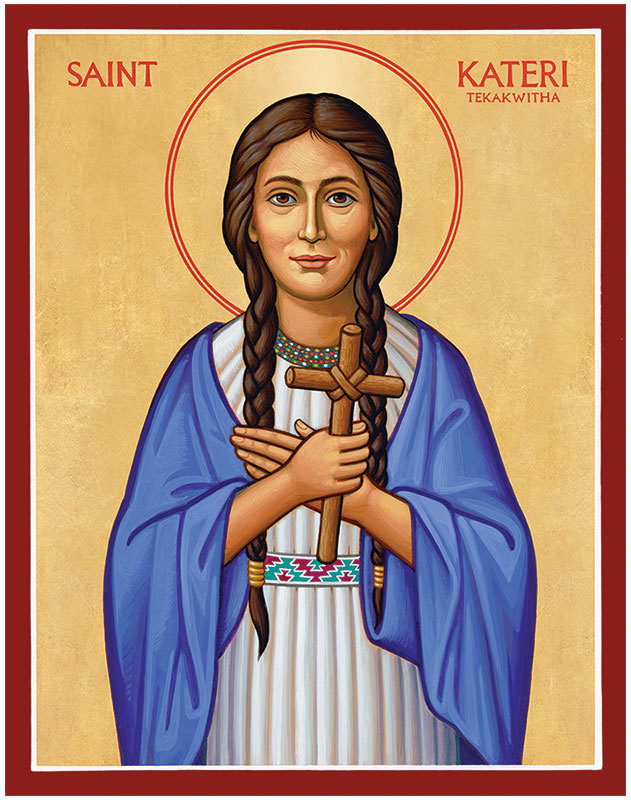
| Feast Day | July 14 |
|---|---|
| Patronage |
|
| Place of Birth | Schenectady, New York, USA |
| Place of Death | Kahnawake, Quebec, Canada |
| Canonization Date | October 21, 2012 |
Biography
St. Kateri Tekakwitha was born in 1656 in what is now New York to a Mohawk chief and a Catholic Algonquin mother. Her early life was marked by tragedy—her parents died when she was young, leaving her orphaned. As a child, she contracted smallpox, which left her with scarring on her face and impaired eyesight. Despite these hardships, Kateri’s faith and spirit remained strong.
Kateri was raised in the Mohawk tribe but encountered the Catholic faith through the Jesuit missionaries who had begun working in the region. At age 19, after much contemplation, Kateri was baptized by a Jesuit missionary and chose the Christian name Kateri (after Catherine of Siena).
Her conversion to Catholicism was a source of great conflict in her community, as many members of her tribe remained opposed to Christianity. Nonetheless, Kateri remained firm in her faith and dedicated herself to living a life of prayer, chastity, and service. She faced persecution and isolation due to her conversion but remained committed to her Christian values.
Kateri later moved to the Jesuit mission of Saint-François-Xavier, near what is now Montreal, where she lived the remainder of her life in devotion to God. She died at the young age of 24 on April 17, 1680. Following her death, people began to venerate her as a model of holiness, and her story spread rapidly among Catholics, particularly in North America.
Kateri Tekakwitha is often remembered as the first Native American saint and one who showed great perseverance in following Christ amidst considerable adversity.
Miracles & Important Events
- Healing Miracle for Canonization: A miracle attributed to St. Kateri’s intercession played a key role in her canonization. In 2006, a young Native American boy named Jake Finkbonner from the Lummi Nation was healed of a severe infection after prayers to Kateri. The boy’s miraculous recovery was confirmed as an unexplained healing, which led to her canonization in 2012.
- Faith Amidst Persecution: Kateri faced significant opposition and even ostracism from her own community for her conversion to Christianity. Despite these challenges, she remained dedicated to her faith, living a life of prayer and penance.
- Baptism and Devotion: Upon her baptism, Kateri Tekakwitha vowed to remain a virgin and dedicated her life to serving God. She lived an ascetic life, often fasting, praying, and spending hours in adoration.
Associated Symbols
- A lily: St. Kateri is often depicted holding a lily, symbolizing her purity and chastity.
- A cross: Represents her Christian faith and dedication to the cross of Christ.
- Native American elements: Often depicted with feathers or in native attire to highlight her heritage.
- A smallpox scar on her face: Sometimes depicted to represent her suffering from smallpox, which left her with scars.
Quotes & Writings
- “I will live my life for God.” — This phrase, often attributed to Kateri, reflects her complete commitment to living out the will of God in her life, even amidst hardship and opposition.
- “Jesus, I love you.” — This simple, heartfelt expression is often associated with her devotion to Christ, and it highlights the purity and simplicity of her faith.