St. Anthony of Padua
| Feast Day | June 13 |
|---|---|
| Patronage |
|
| Place of Birth | Lisbon, Portugal |
| Place of Death | Padua, Italy |
| Canonization Date | May 30, 1232 |
Biography
St. Anthony of Padua, a Franciscan friar, is one of the most beloved and widely known saints in the Catholic Church. Born Fernando Martins de Bulhões in Lisbon, Portugal, he came from a wealthy family and was educated at a young age to become a priest. Initially, Anthony joined the Augustinian order but later switched to the Franciscans after he was inspired by the martyrdom of five Franciscans in Morocco. He took the name Anthony after joining the Franciscans.
Anthony spent his life traveling and preaching, particularly in Italy, where he became known for his powerful sermons and his ability to convert people through his eloquence and deep spirituality. He was also a gifted theologian and scholar, and his writings and teachings contributed greatly to the development of Catholic theology.
St. Anthony’s reputation grew not only for his sermons and teachings but also for his deep compassion for the poor and suffering. His ability to perform miracles during his lifetime further solidified his sainthood, and he is often invoked for his intercession in finding lost or stolen items, leading to him being popularly known as the patron saint of lost things.
St. Anthony died at the young age of 36 and was canonized just over a year after his death. He is remembered as a humble and dedicated servant of God, a great preacher, and a compassionate friend to the poor and suffering.
Miracles & Important Events
- The Miracle of the Donkey: One of the most famous stories associated with St. Anthony is the miracle of the donkey. When heretics in Rimini refused to listen to Anthony preach, he reportedly went to the marketplace and preached to the fish in the river. According to legend, the fish gathered and listened attentively, a miracle that caused many people to convert.
- Miracles of Healing: St. Anthony was also known for his ability to heal the sick, and many miracles of healing are attributed to him, both during his life and after his death.
- Restoration of Lost Items: As the patron saint of lost things, countless miracles of lost items being found after invoking St. Anthony’s name have been recorded throughout history.
- Sermons and Conversions: St. Anthony was a gifted preacher, and his sermons led many to convert to Christianity. He was also known for his ability to settle disputes and bring peace to conflicted communities.
Associated Symbols
- The Lily: Often depicted with a lily, which symbolizes purity, reflecting his life of chastity and holiness.
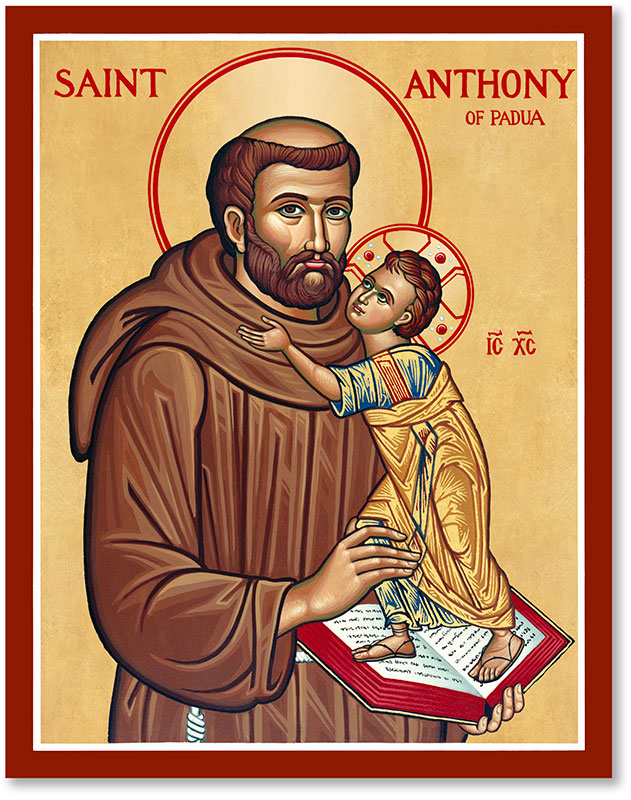
- The Book: Represents his theological wisdom and his role as a teacher and preacher of the faith.
- The Child Jesus: St. Anthony is often shown holding the Child Jesus, symbolizing his closeness to the Christ child and his deep love for Christ.
- The Heart: Represents his deep love for God and his compassion for others.
- The Flame: Sometimes shown with a flame above his head, representing his fiery passion for preaching the Gospel and his zeal for the faith.
- The Fish: In some depictions, he is shown with a fish, symbolizing his miracle of preaching to fish when the people of Rimini refused to listen to him.
Quotes & Writings
St. Anthony of Padua is known for his deep spirituality and insightful teachings. Some of his quotes include:
- “Actions speak louder than words; let your words teach and your actions speak.”
- “Charity is the soul of the Law, the perfection of the Gospel, the bond of peace and of union with God.”
- “The deeds you do may be the only sermon some people will hear today.”
- “O, my God, give me the grace to love You above all things, to serve You in the love of my neighbor, and to make my actions a reflection of Your love and peace.”
- “Preach the Gospel at all times and when necessary use words.” — (This quote, although often attributed to St. Francis, reflects the core teaching of both saints on how we should live out our faith through action.)