Feast Day: St. Monica - August 27 • Learn more about St. Monica
St. Augustine of Hippo
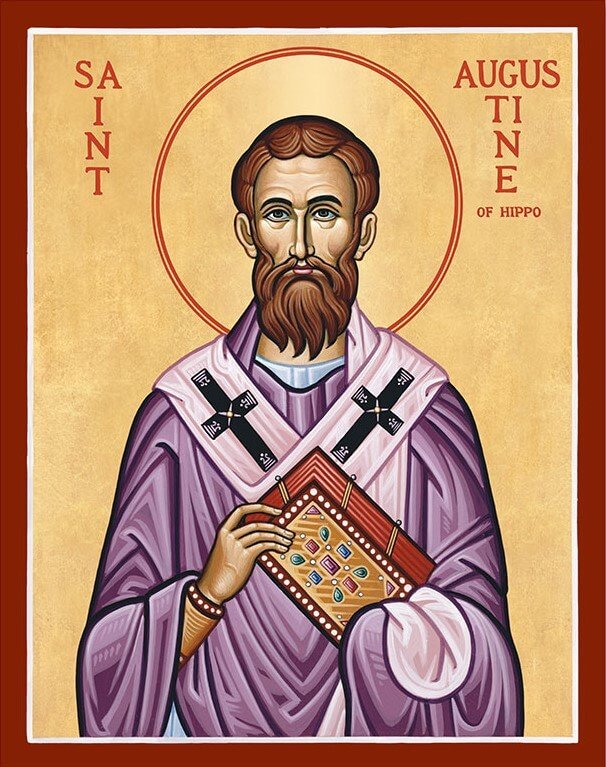
| Feast Day | August 28 |
|---|---|
| Patronage |
|
| Place of Birth | Thagaste, Numidia |
| Place of Death | Hippo Regius, Numidia |
| Canonization Date | N/A |
Biography
St. Augustine of Hippo was one of the greatest theologians and philosophers of the early Church. Born to a pagan father and a devout Christian mother, St. Monica, Augustine lived a hedonistic life in his youth, seeking pleasure and knowledge in various philosophies. After years of searching, he underwent a dramatic conversion at the age of 32, inspired by the prayers of his mother and the preaching of St. Ambrose of Milan. He became a bishop, a prolific writer, and one of the most influential Church Fathers, shaping Christian doctrine on grace, free will, and original sin. His Confessions remains one of the most famous autobiographical works in history.
Miracles & Important Events
- Conversion from a life of sin: His transformation from a worldly philosopher to a devoted Christian is one of the most famous conversions in Church history.
- Influence on Christian doctrine: He wrote extensively on original sin, grace, and predestination, influencing both Catholic and Protestant theology.
- Defended the Church against heresies: He was a leading opponent of Manichaeism, Donatism, and Pelagianism.
- The Sack of Hippo (430 AD): As the Vandals invaded North Africa, Augustine stayed with his people, writing and praying until his death.
Associated Symbols
- Heart on fire: Symbolizing his passionate love for God and truth.
- Book and quill: Representing his extensive theological writings.
- Child and seashell: A legend tells of a boy trying to empty the ocean with a shell, illustrating the mystery of the Trinity—similar to Augustine’s search for divine understanding.
- Bishop’s staff and robes: Denoting his role as Bishop of Hippo.
Quotes & Writings
- “You have made us for Yourself, O Lord, and our heart is restless until it rests in You.” — Confessions
- “Faith is to believe what you do not see; the reward of this faith is to see what you believe.”
- “Love, and do what you will.”
- “Right is right even if no one is doing it; wrong is wrong even if everyone is doing it.”
- Major works include Confessions, The City of God, On Christian Doctrine, and On the Trinity.